
Two teams agreed to a blockbuster more than a week ago, and it still has not happened. On June 30 the Los Angeles Clippers agreed to send Kawhi Leonard back to the Toronto Raptors, the franchise where he won a championship in 2019, for Brandon Ingram, Gradey Dick, two first-round picks, a pick swap, and two second-rounders, per Front Office Sports. Every piece is in place. The trade is not official, and it will not be until the NBA finishes deciding whether the Clippers cheated to keep Leonard in the first place. That is the part that makes this more than a transaction. The delay is the story.
A Deal Both Sides Agreed To, Frozen in Place
Trades of this size are usually a formality once the terms leak. This one is stuck. Hoops Rumors reported on July 9 that the deal has been placed on hold until the league concludes its investigation into the Clippers’ relationship with Aspiration, the now-bankrupt green-banking startup at the center of a salary-cap circumvention probe. Commissioner Adam Silver told reporters before the Finals that the investigation would “wrap up shortly.” A month later, there is no ruling and no trade.
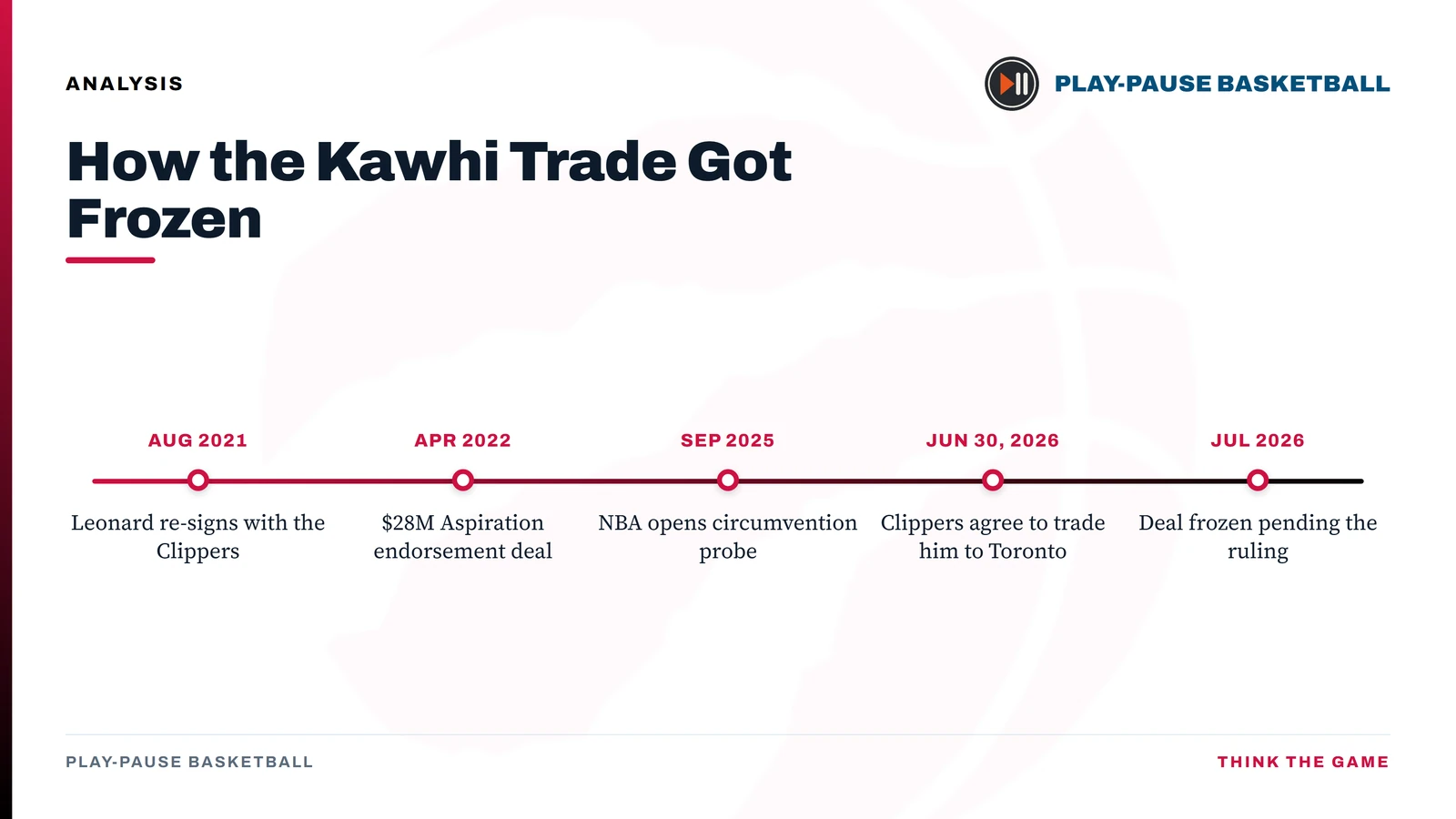
The mechanics matter here. A trade is not real until the league office processes it, and the league is not going to process a deal built around a contract it might be about to void. So the two sides did the only thing they could. They agreed to terms, then agreed to wait. Leonard is in the final year of a $50.3 million contract and eligible for a two-year, $123.7 million extension, per Front Office Sports, which means the asset Toronto is trading for is not just a player but a specific, expensive piece of paper the NBA is actively examining.
The $28 Million Question Hanging Over the Clippers
To understand the freeze you have to go back to April 2022, months after Leonard re-signed in Los Angeles. That is when he signed a four-year, roughly $28 million endorsement deal with Aspiration. The problem, as laid out in Pablo Torre’s Pulitzer-winning reporting, is what the deal did not require: Leonard reportedly never appeared in any marketing for the company. Torre’s sources described it as a no-show job, extra money routed to a star already at the cap.
The thread runs deeper than one contract. Clippers owner Steve Ballmer invested tens of millions into Aspiration himself, and Torre reported that a Clippers limited partner put nearly $2 million into the company nine days before Aspiration made an overdue $1.75 million payment to Leonard. String those together and you see why the league hired the law firm Wachtell, Lipton, Rosen & Katz in September 2025 and has spent the better part of a year on it.
The reporting that opened the investigation came from the podcast "Pablo Torre Finds Out," which won a Pulitzer Prize for its audio investigation into the Clippers' alleged cap circumvention. Yahoo Sports
Ballmer’s defense is that he was a mark, not a mastermind. He has said publicly that he was duped, casting himself as a victim of a fraud run by Aspiration co-founder Joe Sanberg, who has since been convicted and sentenced to 14 years. That may well be true. It also may not fully matter, because cap circumvention is judged on what happened to the cap, not on who felt cheated at the end of it.
What the NBA Can Actually Take Away
Here is where most coverage stops short, so let us be specific about the menu of outcomes. If the league finds the Clippers circumvented the cap, its own precedent gives it real teeth. The clearest comparison is the Joe Smith case in Minnesota more than 25 years ago, when the league stripped the Timberwolves of five first-round picks, fined the franchise $3.5 million, and voided Smith’s contract outright.
Apply that to now and the penalties sort into two very different buckets. Fines and forfeited picks land on the Clippers and would sting Los Angeles without touching the trade. A voided contract is the nuclear option, and it is the only one that actually detonates the deal, because you cannot trade a contract that no longer exists. That single distinction is why the trade is frozen rather than dead. Everyone is waiting to learn whether the punishment, if there is one, stays on the Clippers or reaches into the contract itself.
Why Toronto Agreed to Hold the Bag
This is the detail that reframes the whole saga. Reporting indicates the trade can be finalized only if Raptors ownership assumes the risk of any penalty tied to Leonard’s contract. Toronto, in other words, is not a bystander waiting on a verdict. It has volunteered to catch whatever the league throws.
An informed fan will push back here, and the objection is fair: how is any team allowed to trade for a player whose contract might be voided? The answer is that no one is, yet. The deal is agreed but deliberately unfiled, and the condition Toronto accepted, eating the downside risk, is precisely the thing that keeps it legal in the meantime. The Raptors are betting that the worst case does not come, or that if it does, the cost is survivable against a healthy Leonard at $50.3 million. That is either shrewd or reckless, and we will not know which until the ruling lands. Both teams proceeding at all suggests they expect the league to stop short of voiding the deal, but expecting is not the same as knowing.
The Ruling Matters More Than the Trade
Strip away the names and this is a governance test. The second apron and the cap have been sold as hard lines, and Aspiration is the case that asks whether a rich owner can quietly route money around them through a side business. If Silver hands down a light penalty, every front office in the league learns exactly how much a creative endorsement is worth. If he voids the contract or guts the Clippers’ draft cupboard, he sets a deterrent that outlasts anything Leonard does in a Raptors jersey.
That is why the interesting question is not whether Kawhi ends up in Toronto. He probably does. The interesting question is what the league says on its way to letting him, because that answer becomes the rulebook everyone else plays by next summer. The trade is the headline. The ruling is the precedent, and the precedent is the part that will still matter long after this deal, in whatever form, finally goes through.