
Silver and Kelly Are Describing the Same Machine
Adam Silver and David Kelly agree on more than either will say out loud. The NBA’s second apron is doing exactly what it was built to do: punish the teams that spend the most to hold their best rosters together. Silver calls that a feature. The players’ union just called it the reason it lost the last labor deal.
New NBPA executive director David Kelly, flanked by union president Fred VanVleet, spent Summer League in Las Vegas turning private grumbling into a public stance. “We are not fans of the second apron. We did not propose the second apron. We should have done a better job of fighting back against the second apron,” Kelly told ESPN, adding that the system forces teams into “decisions that are not basketball decisions.” Days later, Silver stood at a podium after the Board of Governors meetings and refused to give an inch. The roster fallout, he said, is “certainly not an unintended consequence.”
That is the whole story in one exchange. This is not a fight over whether the apron works. It is a fight over whether its working is a good thing.
The Players Are the Ones Paying the Apron Bill
Strip out the labor-relations language and the union’s complaint gets concrete: the apron’s cost is landing on players and on continuity, not on owners. VanVleet framed it as a widening coalition. “It’s almost a consensus that it’s something that needs to be addressed,” he said, pointing to the front offices and agents who now share the concern.
The players are not being quiet about it either.
Kyle Kuzma is saying in public what the union is saying in meetings: a system sold as parity is starting to behave like a hard cap on player pay and player movement. That is the argument’s emotional core, and it is why Kelly keeps returning to specific teams instead of spreadsheets.
Per David Kelly, to the Boston Globe, the league needs "better exceptions to that second apron" so a contender is not forced to break up a homegrown core the way Boston did.
One Wembanyama Discount Nearly Covers the Entire Buffer
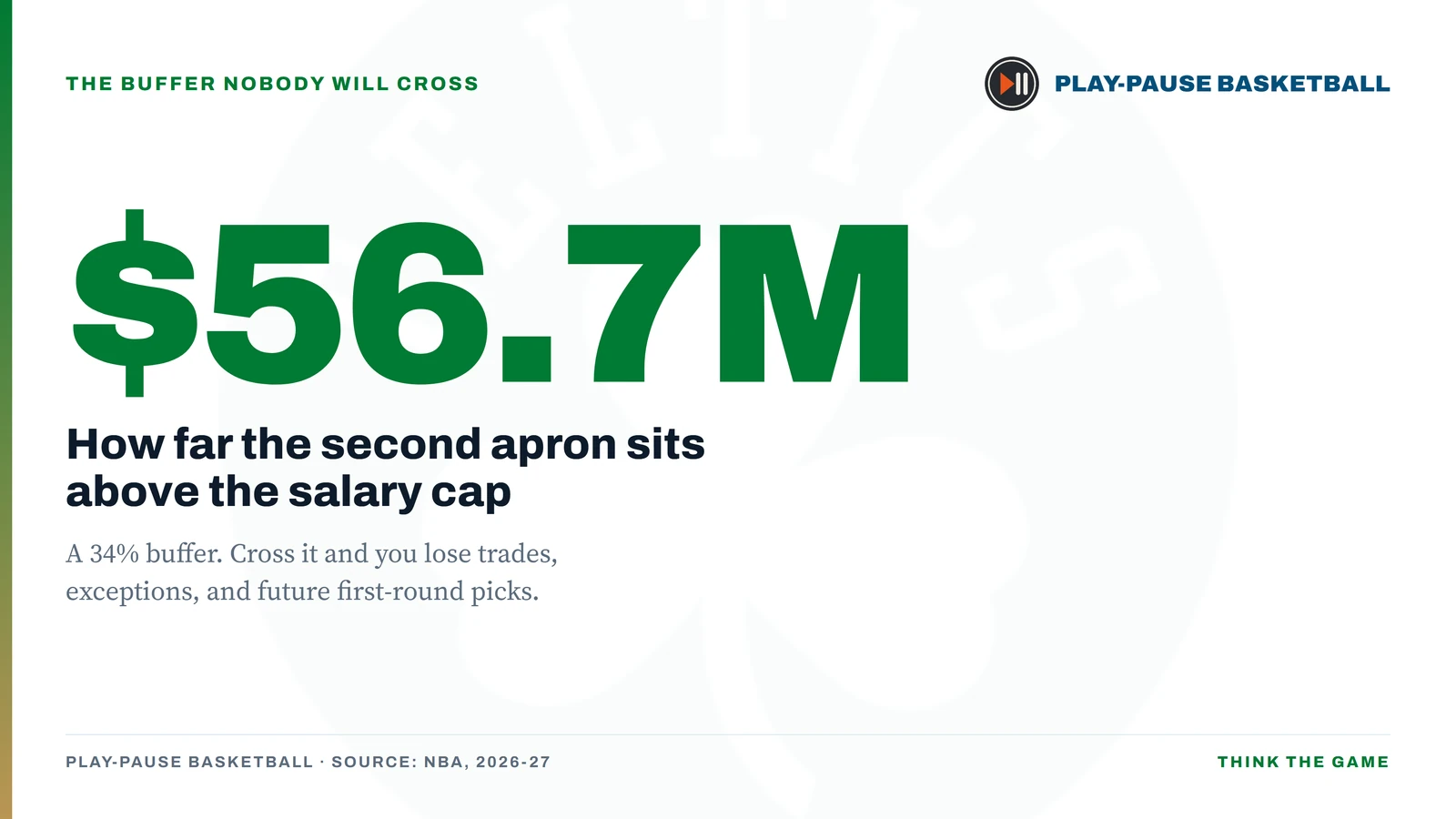
Here is the number the wire coverage skips past. For 2026-27 the salary cap sits at $164.961 million and the second apron at $221.686 million.
Do the subtraction and the punitive zone is $56.7 million wide, a 34 percent buffer above the cap. That gap is the union’s entire case in one figure, because a single player just absorbed almost all of it himself. Victor Wembanyama signed a five-year, $252 million extension with San Antonio this month, taking the 25 percent maximum instead of the 30 percent escalators that would have pushed the deal past $303 million.
A generational center handed his team close to $50 million in flexibility so it could build around him without tripping the apron. Kelly’s point is that the CBA now asks players to make that choice. Silver’s point is that Wembanyama made it, and the Spurs stayed a contender, so the machine is working as intended. Both reads are correct.
A Title Team That Refused to Cross the Line
The honest counter to the union is that the apron is barely being triggered. Just one team, Cleveland, finished last season above the second apron, absorbing the penalties that come with it: no trade aggregation, no mid-level exception, and first-round picks frozen years out. If the mechanism were truly decimating the league, you would expect a pile of bodies, not a single one.
You would also expect owners to resent it. Instead, they are policing themselves.
James Dolan said that days after the Knicks won the 2026 title, their first since 1973, a championship they earned while staying under the second apron the entire way. A big-market owner with a bottomless checkbook treats the line as sacred, and just won without crossing it. That is the best evidence Silver has, and it is why he can say no without blinking. The goal was never a different champion every year, he argued, yet “we’ve had eight different champions over the last eight years.”
The union has no rebuttal to the scoreboard. What it has is a calendar.
This Isn’t a Negotiation. It’s the Union’s 2029 Brief.
Kelly is not actually asking Silver to reopen the CBA this summer, and Silver’s flat “one person’s tweak is another person’s overhaul” makes clear he would not entertain it if he were. The current agreement runs through the 2029-30 season, with the first opt-out after 2028-29. Nothing about the apron moves before then.
So read the Las Vegas offensive for what it is: the opening statement of a case the union does not get to argue for three more years. Kelly is assembling a public record now, with Wembanyama’s discount and Brown’s trade as exhibits, so that “the apron is broken” reads as the accepted premise by the time the sides sit down. Silver is assembling the opposite record, one title banner at a time.
The apron works. That is not the union’s rebuttal. That is the thing it has to overcome.