
Boston did not get worse by accident this week. On July 6 the Celtics traded Jaylen Brown, a 29-year-old who finished sixth in MVP voting last season, to the division-rival Philadelphia 76ers for a 36-year-old Paul George and a stack of draft picks. Read that sentence again and try to find the basketball in it. There isn’t any. This was not a trade Boston made to win a game next April. It was a trade Boston made to admit something it spent three years refusing to say out loud.
The Celtics Blinked on Their Own Title Core
Start with what left the building. Brown averaged 28.7 points, 6.9 rebounds and 5.1 assists across 71 games in 2025-26, the second-best scoring season of his career and a top-six MVP finish. He is 29. He has three years and roughly $183 million left on his deal, the supermax he earned by being the second star on a championship team. Players like that do not get moved. When they do, the team moving them is telling you the plan changed underneath their feet.
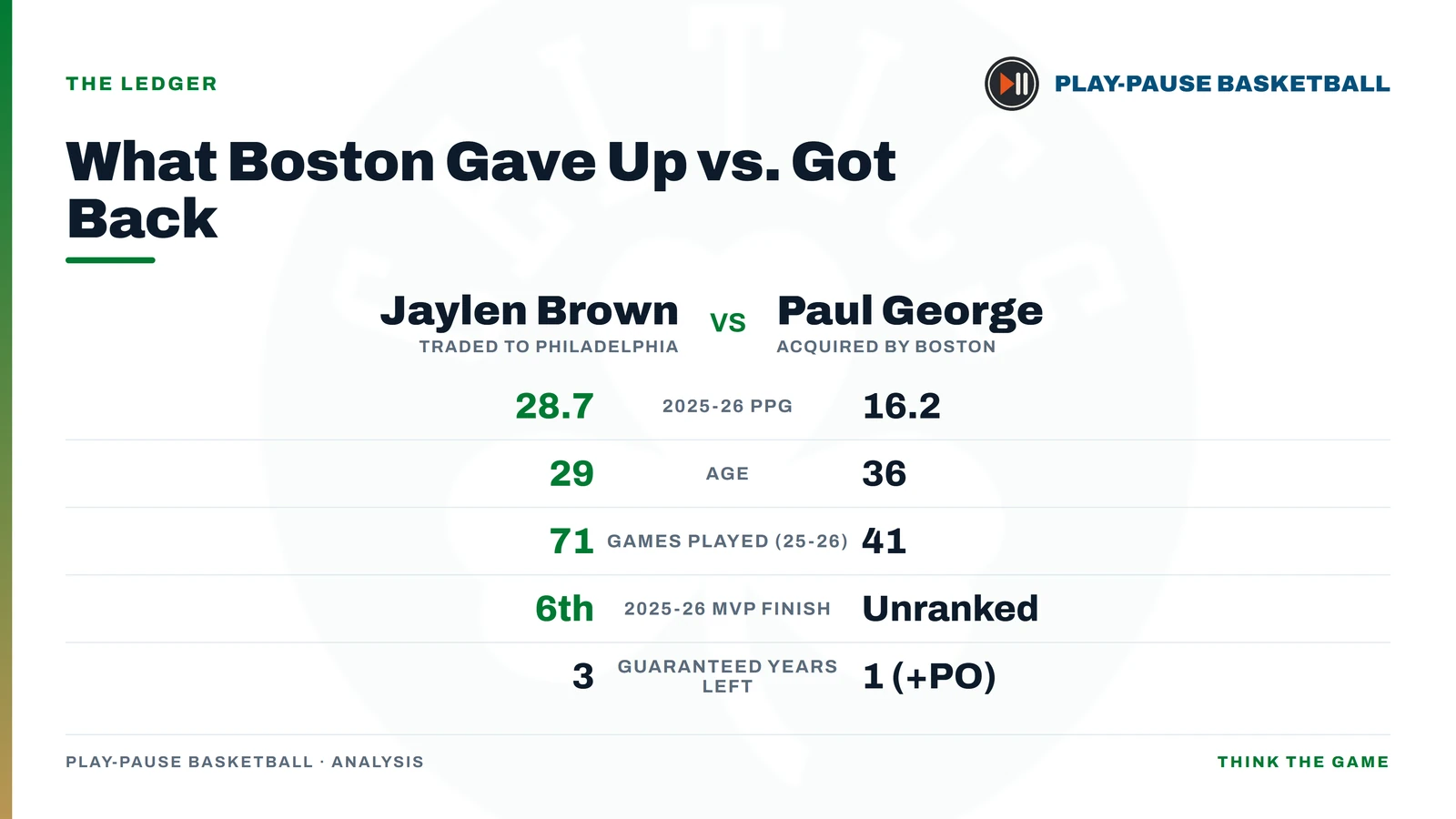
Now look at what came back. Paul George is a very good player having a hard year. He put up 16.2 points in just 41 games last season, the lowest full-season scoring average of his career, and he has played only 78 games across two seasons in Philadelphia. He turns 37 in the spring. On talent alone this is one of the more lopsided swaps a contender has volunteered for in years, and the Celtics know it better than anyone. That is the tell. Nobody does this for the player. They do it for what the player’s contract unlocks.
The Second Apron Wrote This Deal Before Brad Stevens Did
Here is the math Boston could not get around. Brown and Jayson Tatum together were on track to swallow close to 70 percent of the salary cap, and under the second apron every dollar past a certain line comes with penalties that go beyond the tax bill: frozen picks, no aggregating salary in trades, a hard ceiling on how you build the other ten roster spots. Derrick White alone is on the books for around $30 million next season. Do the subtraction and Boston was staring at something like $20 million to fill out eleven jobs.
Brad Stevens did not pretend otherwise. The Celtics president framed the move as a cap decision rather than a basketball one, describing a path forward that had gotten meaningfully harder with roughly 70 percent of the cap, and a huge share of the team’s usage, tied up in just two players. That is a front office telling you the roster was mathematically finished, not that it had stopped being good. Brown was also eligible this month for a two-year extension worth a reported $141 million, with Tatum due for a similar number next summer. Two supermax deals is a fine problem to have if it is a title formula. Boston decided it wasn’t, and moved the one it could still move for value.
Paul George Isn’t the Return. He’s the Receipt.
This is where the grades get it backward. George is not the asset Boston chased. The picks are. Philadelphia sent out two first-round picks, including a 2031 unprotected first and a 2028 pick that can convert into a favorable swap tied to the Clippers selection the Sixers control, plus two second-rounders. George’s expiring-ish contract, one guaranteed year at $54.1 million with a player option after, is the mechanism that made the salaries match and the apron math survivable. He is the receipt stapled to the picks, not the purchase.
That reframes the whole thing. If you believe Boston flips George’s money and those picks into a younger co-star inside a year, this looks like a reset with a plan. If you believe they just took the best offer for a player they had soured on, it looks like a salary dump wearing a nicer suit. The truth is probably in between, and Boston’s history under Stevens earns them a little benefit of the doubt. A little.
Now Everything Rests on Jayson Tatum’s Repaired Leg
None of this works if the last star standing isn’t a star. Tatum spent most of last season sidelined, rehabbing a serious leg injury, watching a team built around him and Brown play without its second engine. Boston is now betting the entire pivot on Tatum returning to the MVP-level form he flashed before the injury, and on doing it as a clear number one with less shooting and creation around him than he has ever had.
That is a real bet, not a sure thing. Achilles and knee recoveries for explosive wings are not automatic, and the Celtics just traded away the exact kind of secondary shot-creator who covers for a slow start. If Tatum comes back at 90 percent, Boston is a good team that gave a division rival an All-NBA scorer. If he comes back at 100 percent, this was a cold, correct piece of cap surgery. The medical staff, not the front office, will decide which sentence gets written.
Grade the Confession, Not the Box Score
ESPN handed Boston a D+ and Philadelphia an A-, and on the merits of the players exchanged, that is defensible. The Ringer’s headline was simply, “What the Hell Is This Jaylen Brown Trade?” I understand the reaction. But grading this on the box score is like grading a bankruptcy filing on the quality of the furniture being sold. It measures the wrong thing.
The honest read is that both sides of the criticism are right at once, and that is what makes it damning. Boston did get worse for next season, and it did strengthen a team in its own division while doing so. And it also had almost no choice, because the roster it built to win a title was never financially repeatable once the extensions came due. The D+ is not wrong. It is just aimed at the trade, when the real failure it exposes is the plan that made the trade necessary. Boston didn’t lose a deal this week. It confessed that the window it thought it had was already closed.