Miami got scarier this month, and the betting market treated scarier like better. Those are not the same thing. On July 6 the Heat completed a trade for Giannis Antetokounmpo, a two-time MVP and one of the five best players alive, and the sportsbooks reacted the way you would expect. What almost nobody folded into the math is that Miami lost its two best shot-creators in the same week it landed him: Norman Powell walked in free agency on July 1, and Tyler Herro was the centerpiece Milwaukee demanded in the deal itself. You cannot add a superstar and subtract your spacing at the same time and call the result a finished contender. Miami did the first two. The odds board only counted the first.
The Giannis Trade Made Miami Scarier. It Did Not Make Them Contenders.
Start with what actually happened, because the transaction is genuinely enormous. Per Shams Charania of ESPN, the Heat sent Herro, center Kel’el Ware, forward Jaime Jaquez Jr., guard Kasparas Jakucionis and a stack of draft capital to Milwaukee for Antetokounmpo and Bobby Portis. This is the kind of swing a franchise makes once a decade, and Pat Riley has never been shy about making it. On the marquee, Miami now runs Giannis and Bam Adebayo as its frontcourt, and that is a terrifying sentence for the rest of the East to read.
The problem is that a marquee is not a rotation. Giannis is a devastating downhill force and a career non-threat from the perimeter outside a brief stretch early in the decade. Adebayo has never been a floor-spacer either. Put them together and you have two of the best interior defenders in basketball sharing a frontcourt, and two players who give an opponent no reason to leave the paint on the other end. That is a fixable problem for a team with shooters around them. It is a fatal one for a team that just traded and lost its shooters in the same seven days.
Why the East’s Odds Board Moved Faster Than Miami’s Roster
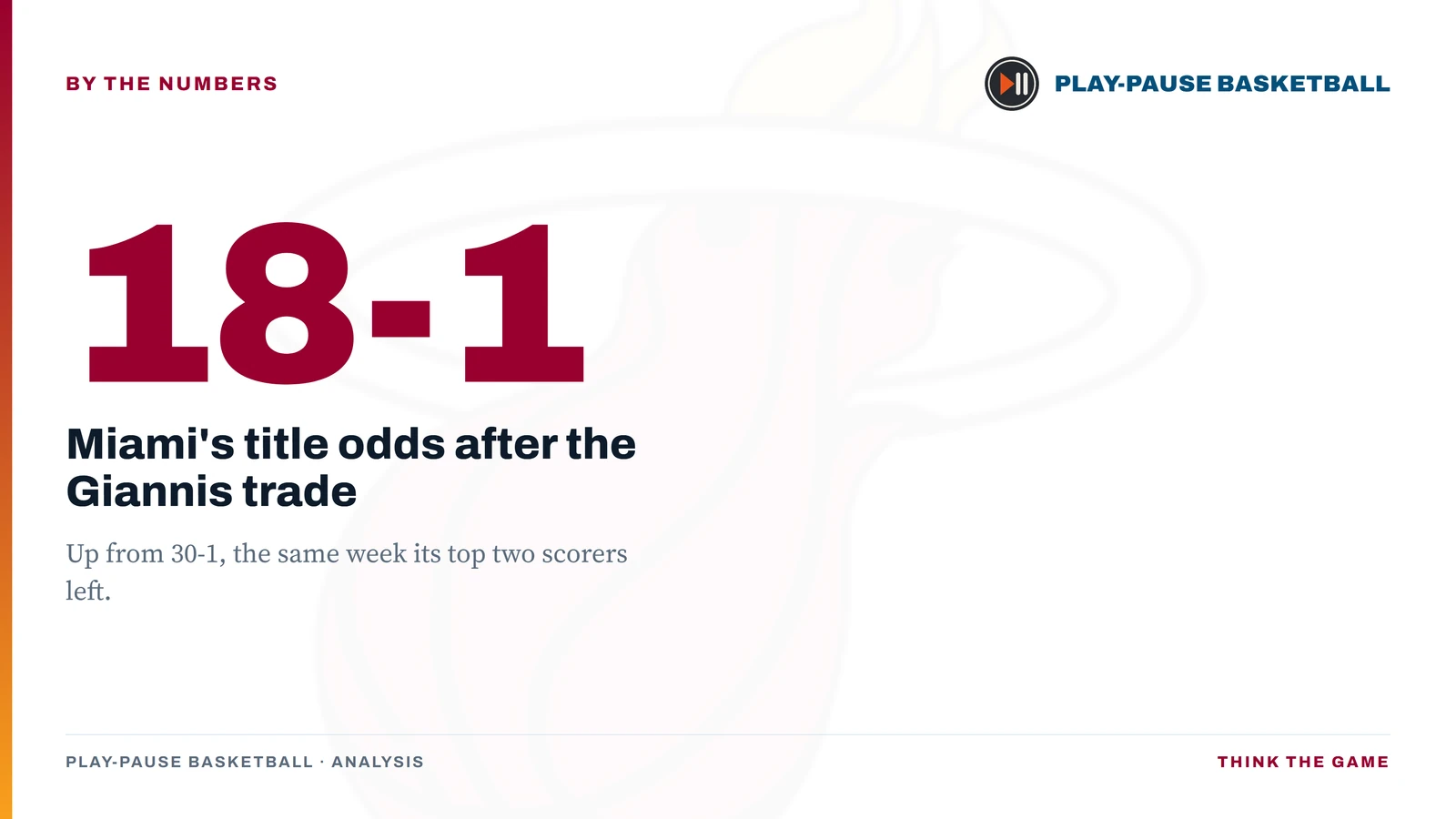
The market did not hesitate. DraftKings cut Miami’s championship odds from 30-1 to 18-1 within a day of the report, and lifted the Heat to third in the East behind Boston and New York. Read as a story about talent, that jump makes sense. Read as a story about a roster, it is running well ahead of the evidence.
Do the arithmetic the books are asking you to accept. Odds of 30-1 imply about a 3.2 percent chance of winning the title; 18-1 implies about 5.3 percent. In one week the market raised Miami’s implied championship probability by nearly two-thirds, on a roster that got worse at the one thing it most needed to protect.
Odds move on names, and Giannis is the biggest name available. But a conference is won in April and May by the fifth-best offensive option knocking down an open corner three, not by the marquee. Miami’s marquee got better. Its fifth option got worse. The board only weighed one of those.
The Same-Week Exits Nobody Connected: Powell Out, Herro Gone
Here is the piece the national takes left on the floor. Norman Powell was Miami’s leading scorer last season, averaging 21.7 points on 47 percent shooting in his lone year with the team, and earning his first All-Star nod. On July 1 he agreed to a two-year deal with the Chicago Bulls. Five days later, the Giannis trade closed, and with it went Herro, the Heat’s returning shot-creation engine and the only guard on the roster who could reliably manufacture a bucket late in a shot clock.
That is not one hole. It is two, opened in the same week, at the exact position the Giannis fit most needs filled. The reporting on the trade cost was blunt about how much Miami paid to open them.
Two unprotected firsts, a lottery pick, a swap and a second, plus the four players. That is a franchise-altering price, and it was paid for a version of Miami that is, right now, shorter on shooting and shot-creation than the team that missed on a deep playoff run last spring. The talent at the top went up. The functional roster, the ten guys who have to space the floor for Giannis, went down.
The Case That Riley Isn’t Done, and Why It’s Still a Bet
The sharpest pushback from a Heat fan is a fair one: you are grading a half-finished roster. Miami kept meaningful flexibility in this deal, Riley has a long history of turning a trade exception or a buyout signing into exactly the shooter a team needs, and there are months between now and the February deadline to patch the spacing. All true. Erik Spoelstra is also the rare coach who has repeatedly dragged undermanned rosters further than their talent, and a Giannis-Adebayo defense could be good enough to win a playoff series almost by itself, the way the 2023 Finals team did with far less.
“Riley will find some” is a projection, not a depth chart.
Grant all of it. The answer is still that a bet on a move that has not happened is not the same as a roster that has, and the current Heat, the one the odds just re-priced, does not have the shooting. It is also harder than his reputation makes it sound. Once a team absorbs a salary the size of Giannis’s, the realistic tools left are the small ones, an exception, a minimum, the buyout market, and a genuine high-volume shooter rarely falls out of that bin. Miami can still get better. It cannot simply assume the best version of the fix. There is also a clock the optimism skips past. Antetokounmpo is not extension-eligible in Miami until January 6, 2027, and he has not won a playoff series since 2022. The Heat mortgaged their draft future for a superstar they cannot yet lock in beyond his current deal, and whose recent playoff record is the one part of his resume that has cooled. That is a defensible gamble. It is not a finished contender, and the difference is the whole point.
What Has to Happen Before Miami Is Actually a Threat
The path is clear, which is the encouraging part. Miami needs at least one legitimate off-the-dribble creator and one high-volume shooter before the playoffs, and it has the tools and the executive to go get them. If Riley lands both, the odds that look early today will look prescient, and a Giannis-Adebayo core with real spacing is a genuine top-three team in the East. If he lands neither, this is a historically good defense attached to an offense that bogs down the moment a playoff opponent walls off the paint, which is precisely what good playoff opponents do.
So watch the margins, not the marquee. The next Heat move that matters is not the one they already made. It is the shooter they have not signed yet. Until that name exists, Miami is scarier than it was, and further from a title than 18-1 wants you to believe.